Post by : Meena
Hassan
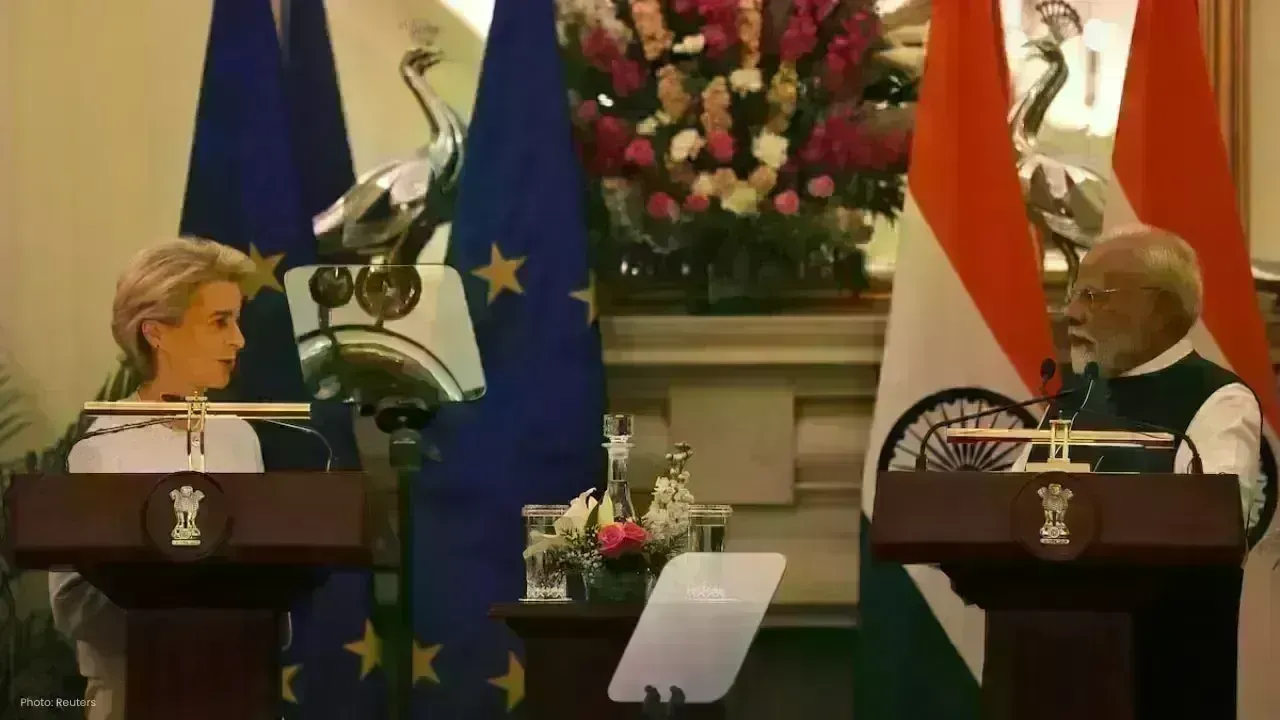
The Republic Day celebrations in India next Monday will see the attendance of European Council President Antonio Luís Santos da Costa and European Commission President Ursula von der Leyen as chief guests. While the ceremonial aspects are significant, the pivotal aim is to bolster trade relations between India and the European Union, especially as the global trade landscape experiences growing uncertainties.
Alongside formal banquets and necessary meetings, discussions pinpointed on expediting the long-awaited India-EU Free Trade Agreement (FTA) will take place between the leaders. With Europe and India keen on forming robust partnerships beyond traditional alliances, these discussions are gaining urgency in light of ongoing tariff disputes with the United States.
The involvement of high-ranking EU officials at a national celebration in India is seen not merely as ceremonial but as a testament to India’s commitment to diversifying its foreign relations while enhancing economic engagement globally.
This engagement comes amidst unresolved trade tensions with the United States, particularly pertaining to a 50% tariff dispute expected to extend into the coming year. In this context, forging closer ties with the EU becomes strategically essential for India.
Hints of a significant breakthrough could emerge as soon as January 27, when leaders from both sides are scheduled to convene during a high-level summit. This prospective agreement is being referred to as the “mother of all deals” by senior officials, underlining its scale and significance.
The negotiations, ongoing for almost two decades, have often been stymied by differences in market access, regulations, and sensitive domestic sectors. The recent developments suggest that both India and the EU may be on the verge of major agreements.
If the trade deal is finalized, it will mark India’s ninth FTA in just four years. The country has actively pursued trade agreements with nations including the UK, Oman, and New Zealand, aiming to expand trade routes and lessen reliance on single markets.
For the EU, this agreement represents an extension of its recent trade engagements worldwide, including agreements with Japan, South Korea, and Vietnam.
The European Union identifies India as a burgeoning global economic player, currently ranking as the fourth-largest economy and one of the fastest-growing major economies globally. Projections indicate India might surpass a $4 trillion GDP, overtaking Japan this year.
EU leaders have asserted that enhanced cooperation with India could yield a vast market of approximately two billion consumers, corresponding to nearly a quarter of global economic activity, which positions India as a crucial long-term associate for Europe.
For India, the EU stands as its largest trading bloc, and a trade agreement stands to elevate India’s exports to European markets. Whereas India exported around $76 billion to the EU, it imported approximately $61 billion, resulting in a favorable trade balance.
A key advantage of this trade deal would be reinstating stronger market access after the withdrawal of the EU’s Generalised System of Preferences (GSP) benefits in 2023, which had previously hampered the competitiveness of many Indian exports within Europe.
Should the FTA come to fruition, India would benefit from reduced tariff burdens on essential export categories such as textiles, pharmaceuticals, and machinery. This would further assist Indian enterprises in weathering the impacts of increased tariffs and market disruptions.
During negotiations, India is expected to safeguard politically sensitive sectors like agriculture. Conversely, tariff reductions in areas such as automobiles and wines may proceed gradually, similar to previous negotiations the country has undertaken.
This incremental approach enables India to make forward strides while reserving the most contentious issues for future discussions, thus managing domestic sensitivities.
Despite the advancements, the agreement does face significant challenges. The EU insists on firmer safeguards concerning intellectual property, data protection, and stronger patent laws.
A point of contention for India is the EU’s newly implemented carbon-related mechanism, CBAM (Carbon Border Adjustment Mechanism), commencing this year. Experts warn that this could impose additional costs on Indian exports, even with lowered import duties from the trade agreement.
This could be particularly burdensome for micro, small, and medium enterprises (MSMEs) due to heightened compliance expectations, complex reporting, and penalties associated with emissions.
Despite the outstanding issues, many believe the India-EU deal could forge a robust long-term partnership. Both parties might gain from minimizing their exposure to sudden tariff shifts, supply-chain disruptions, and fluctuating trade policies from major nations.
Concerns have also surfaced in Europe regarding human rights and India’s carbon emissions, likely igniting discussions in the EU parliament, where legislative approval will be necessary for the deal to be enacted.
Analysts note that India’s reported decrease in Russian crude oil purchases might enhance the European acceptance of this trade deal.
Currently, the negotiation pace has quickened as both regions recognize the critical need for stable trade alliances amidst escalating geopolitical uncertainties. With global trade increasingly shaped by political dynamics, both India and Europe appear poised to make a significant stride toward a closer economic bond.
If finalized, this agreement could emerge as one of the most consequential trade accords for India in recent years, serving as a strategic advantage for Europe’s endeavors to secure dependable partners in Asia.


 English