Post by : Bianca
Haleem
The UAE has recorded a significant milestone in falcon conservation after scientists confirmed that a Peregrine falcon released through the Sheikh Zayed Falcon Release Programme successfully reached Siberia and bred there.
The discovery provides new evidence that falcons released under the UAE’s long-running conservation programme can survive, adapt to natural conditions and return to suitable breeding habitats.
The programme operates under the vision and continued support of His Highness Sheikh Mohamed bin Zayed Al Nahyan, President of the UAE, and reflects the country’s broader commitment to protecting wildlife while preserving its cultural heritage.
Sheikh Zayed Falcon Release Programme
Established in 1995, the Sheikh Zayed Falcon Release Programme has released more than 2,400 Saker and Peregrine falcons into their natural habitats across Central Asia and along the migratory routes of Peregrine falcons travelling towards Siberia.
The initiative was inspired by the environmental legacy of the UAE’s Founding Father, the late Sheikh Zayed bin Sultan Al Nahyan, who placed wildlife and environmental protection at the centre of the country’s development.
The programme aims to strengthen wild falcon populations while promoting more responsible and sustainable falconry practices.
First Direct Confirmation of Falcon Breeding in Siberia
Satellite tracking in previous years had shown that some released falcons travelled north towards Siberia during their migration and breeding seasons.
However, the latest discovery marks the first direct field confirmation that one of these released falcons successfully bred in Siberia.
Read Also: UAE Supports Stronger GCC-ASEAN Cooperation in Jakarta
Russian scientists observed a female Peregrine falcon nesting on the Taz Peninsula in Siberia. They monitored the bird through important stages of its breeding cycle, including egg-laying, hatching and the mother’s care of her chicks.
Identification markings on the female confirmed that she had originally been released in Kazakhstan through the UAE’s Sheikh Zayed Falcon Release Programme.
The finding supports earlier satellite-tracking data and provides direct scientific evidence of the long-term impact of the UAE’s falcon conservation efforts.
49 Falcons Released in Kazakhstan This Year
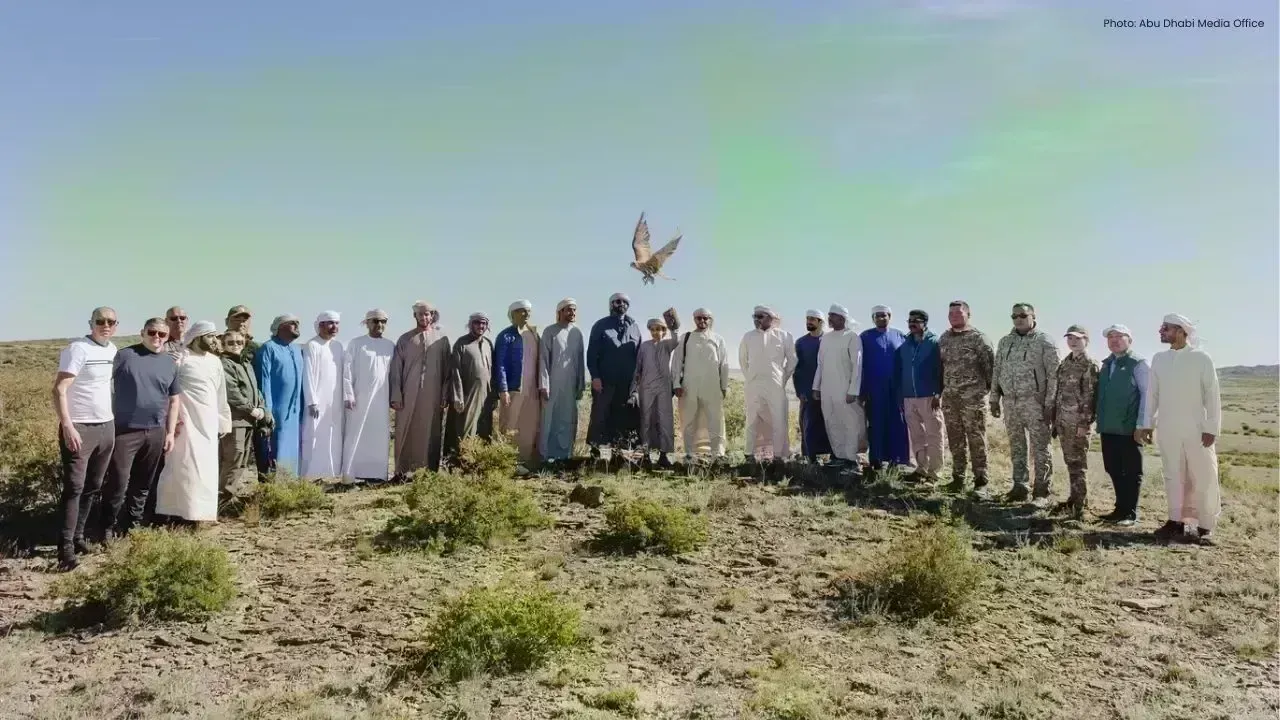
The programme continued in Kazakhstan for the 18th consecutive year this year.
A total of 49 Saker and Peregrine falcons were released in different natural environments, including plains and highland areas within Saker falcon habitats and along the seasonal migration routes used by Peregrine falcons travelling towards Siberia.
To support scientific research, 20 falcons were fitted with satellite-tracking devices. The programme used both tracking models that had proved successful in previous years and newer, lighter devices.
The tracking technology helps researchers study the birds’ survival rates, movements, dispersal patterns and migration routes. The information collected can also help improve future rehabilitation and release methods.
All released falcons were fitted with electronic microchips and identification rings to support long-term monitoring and scientific identification.
UAE Expands Raptor Conservation Efforts
The UAE’s wildlife conservation strategy extends beyond the release of falcons.
The Mohamed bin Zayed Raptor Conservation Fund supports projects designed to protect birds of prey and their natural habitats.
In Mongolia, the Fund’s artificial nest project contributes between 2,000 and 3,000 falcons annually. Other conservation initiatives have helped protect an estimated 18,000 birds of prey each year, including around 4,000 Saker falcons, by reducing the risk of electrocution from power transmission lines.
These projects are aimed at reducing threats to wild raptor populations and improving the long-term survival of vulnerable species.
Sustainable Falconry and Wildlife Protection
The UAE’s conservation approach seeks to connect falconry with modern environmental protection.
Captive-breeding programmes and the responsible use of captive-bred falcons in sustainable hunting can help reduce pressure on wild populations while allowing falconry to remain an important part of the UAE’s cultural heritage.
The approach also includes regulating falcon trade and promoting scientific and veterinary standards designed to support species conservation.
The Mohamed bin Zayed School of Falconry and Desert Lore was established as an educational and cultural platform to pass falconry knowledge and traditions to younger generations while encouraging greater respect for wildlife and the environment.
Houbara Conservation Also Plays a Key Role
The UAE’s conservation efforts also focus on the Houbara bustard, a species closely associated with falconry and desert ecosystems.
The International Fund for Houbara Conservation (IFHC) has developed into a major institution specialising in Houbara breeding and conservation. Its annual production is approaching 100,000 birds, supporting conservation releases into the wild and sustainable hunting practices.
Together, these initiatives form part of a broader strategy that combines cultural heritage, scientific research, biodiversity protection and sustainable wildlife management.
International Cooperation Strengthens Conservation
The success of the Sheikh Zayed Falcon Release Programme has been supported by cooperation between several UAE and international organisations.
The programme involves the Environment Agency – Abu Dhabi (EAD), the Ministry of Climate Change and Environment, the Mohamed bin Zayed Raptor Conservation Fund, the International Fund for Houbara Conservation and the Abu Dhabi Falcon Hospital.
The initiative also receives support from the Presidential Court and the UAE Embassy in Kazakhstan.
The UAE has also recognised the role of Kazakhstan’s Forestry and Wildlife Committee under its Ministry of Agriculture and other relevant authorities in facilitating the programme’s field activities.
International scientific cooperation was particularly important in confirming the Peregrine falcon’s successful breeding in Siberia.
Conservation and Heritage Working Together
Mohamed Ahmed Al Bowardi, Vice Chairman of the Board of Directors of EAD and the Mohamed bin Zayed Raptor Conservation Fund, said the programme demonstrates that preserving heritage goes beyond simply celebrating traditional practices.
He stressed that heritage can also be developed in ways that support environmental and ethical values, creating a model that combines cultural preservation with wildlife conservation.
The latest Siberia discovery strengthens that message by showing that conservation programmes can produce measurable results over many years.
What Does the Siberia Discovery Mean?
The confirmed nesting of a released Peregrine falcon in Siberia is important because it demonstrates that a bird released through the UAE programme was able to:
- Survive after being released into the wild.
- Adapt to natural environmental conditions.
- Complete its migration towards Siberia.
- Reach a suitable breeding habitat.
- Successfully lay eggs and raise chicks.
- Return to a natural breeding cycle.
The discovery also demonstrates the value of combining satellite tracking with direct field observations. While tracking devices can show where birds travel, field research can provide direct evidence of breeding and survival.
A Long-Term Model for Falcon Conservation
The UAE’s falcon conservation programme represents a long-term effort to protect wildlife while maintaining an important cultural tradition.
From the release of thousands of falcons to satellite tracking, captive breeding, artificial nesting projects and international scientific cooperation, the programme brings together traditional knowledge and modern conservation methods.
The successful nesting of a UAE-released Peregrine falcon in Siberia is therefore more than an individual wildlife discovery. It provides evidence of the potential long-term impact of coordinated conservation efforts and highlights the importance of protecting migratory routes and natural habitats across national borders.
The UAE’s approach continues to position falconry as an evolving practice based on responsibility, biodiversity conservation, scientific research and respect for nature, helping ensure that both wildlife and cultural heritage can be protected for future generations.


 English