Post by : Shweta
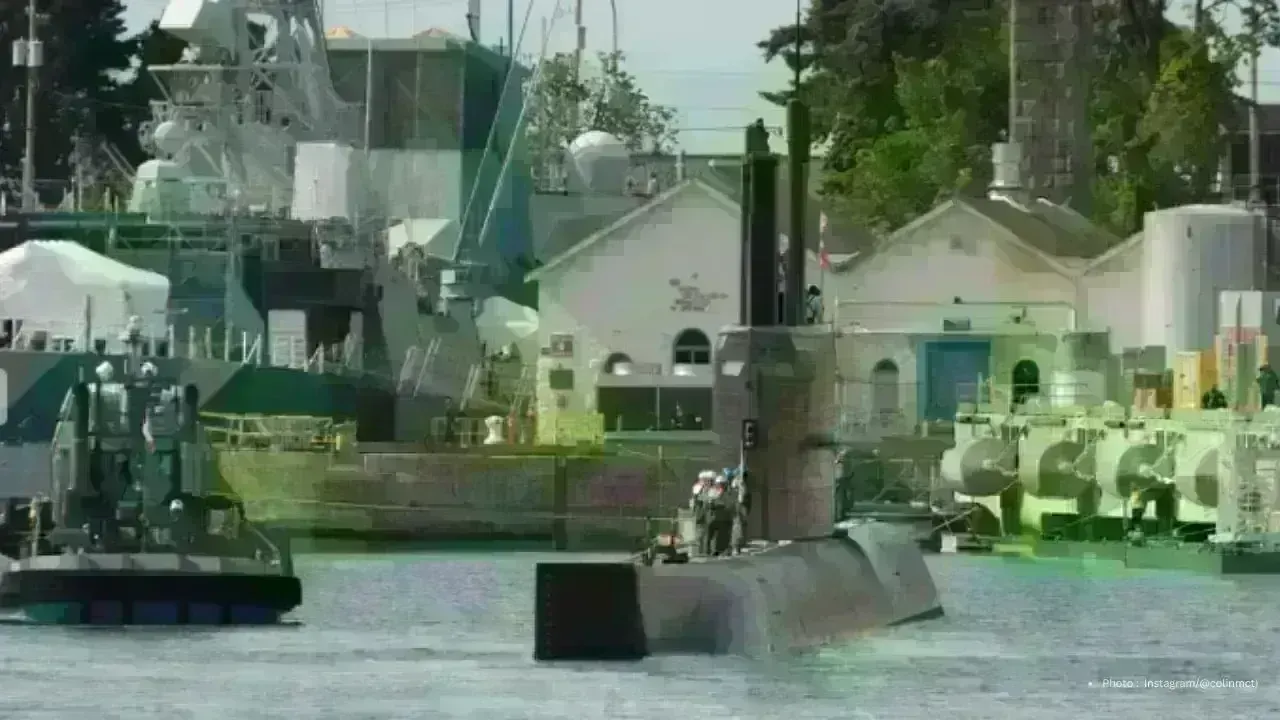
The South Korean navy's ROKS Dosan Ahn Changho has successfully arrived at Canadian Forces Base Esquimalt in British Columbia, after achieving a remarkable trans-Pacific crossing that has set a new benchmark for South Korea's submarine capabilities. The submarine covered over 14,000 kilometers, marking an unprecedented mission for South Korean naval operations.
Accompanying the ROKS Dosan Ahn Changho at CFB Esquimalt was the South Korean frigate ROKS Daejeon, with both vessels departing from South Korea in March. During their journey, the military ships made notable stops in Guam and Hawaii before heading to Canada. This deployment is regarded as one of the most significant operations in the history of the Republic of Korea Navy’s submarine fleet, showcasing the submarine's advanced operational abilities and endurance.
Part of South Korea's KSS-III program, the Dosan Ahn Changho is the nation's first domestically designed large submarine. It features cutting-edge lithium-ion battery technology and an air-independent propulsion system, enabling it to sustain underwater operations for extended durations. Experts assert that these advancements make it well-suited for long-range missions and modern combat scenarios.
The timing of the submarine's arrival is particularly pivotal, as Canada seeks to modernize its aging Victoria-class submarine fleet. The government intends to procure up to 12 new submarines under the Canadian Patrol Submarine Project, a multi-billion-dollar initiative designed for long-term investment. One of the key contenders for this project is the South Korean defense firm Hanwha Ocean, which offers the KSS-III design for consideration by the Royal Canadian Navy.
Analysts view the successful Pacific crossing as a strategic showcase aimed at illustrating the submarine's reliability to Canadian defense officials. Canada is in search of submarines capable of extended operations in the Pacific, Atlantic, and Arctic waters. The journey's success highlights the submarine's alignment with Canada's complex naval operational needs.
Reports indicate that Royal Canadian Navy personnel participated in segments of the voyage, engaging in a military exchange program with their South Korean counterparts. This experience provided Canadian crew members with valuable insights into the submarine's capabilities under real-world conditions, fostering stronger future military relations between Canada and South Korea.
Upon docking at CFB Esquimalt, the submarine will engage in joint naval exercises with the Royal Canadian Navy before proceeding to the multinational RIMPAC 2026 military exercise. Additionally, South Korea plans to deploy further advanced naval assets to this exercise, underscoring its increasing commitment to international maritime security initiatives.
This visit has elicited significant interest among defense analysts, given that Canada's decision on submarine replacements is viewed as one of its most crucial military procurement projects in recent history. Besides South Korea's proposal, German firm ThyssenKrupp Marine Systems is vying for the contract as well. Observers believe that the outcome could significantly influence Canada's naval strategy and its defense partnerships within the Indo-Pacific region for years to come.


 English