Post by : Bianca
Haleem
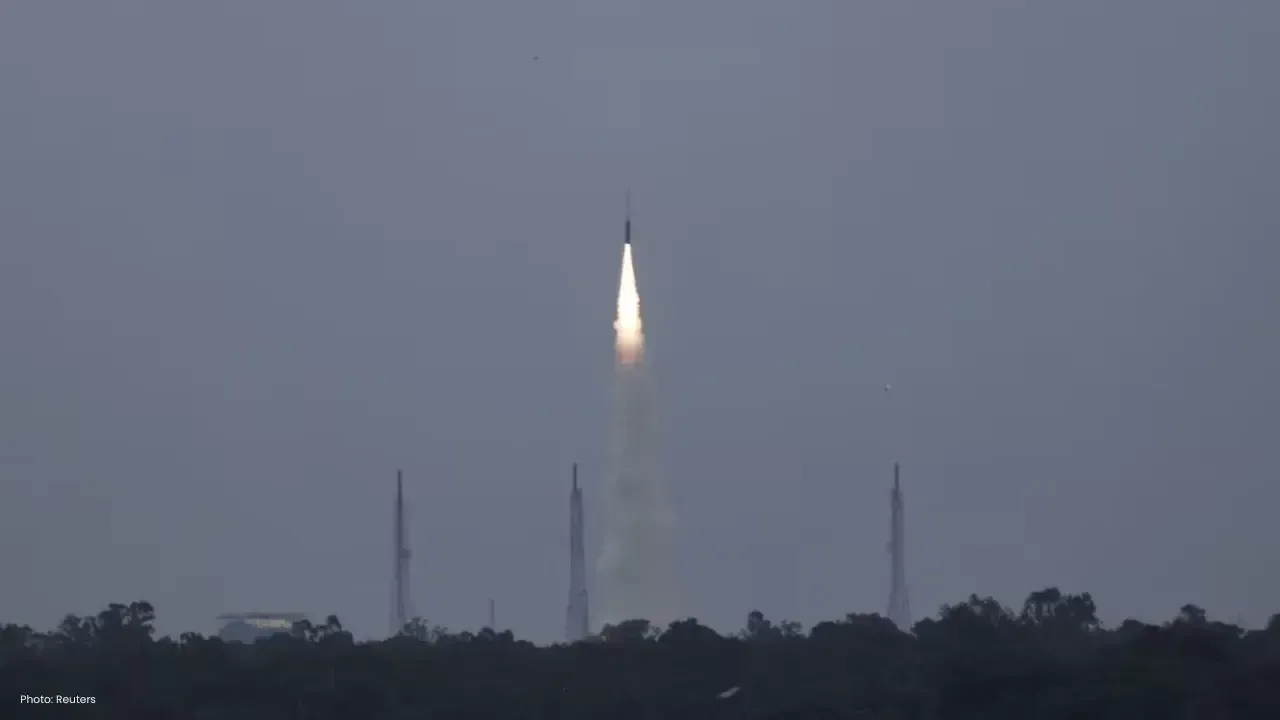
Skyroot Aerospace, an Indian space startup, has achieved a milestone by launching Vikram-1, India's first privately developed orbital rocket, on Saturday. This launch signifies a pivotal moment in India's ambitions to enhance its role in the global commercial space launch arena.
The rocket took off from the Satish Dhawan Space Centre, Sriharikota, at 0635 GMT during its inaugural orbital mission, referred to as Mission Aagaman. As Vikram-1 ascended, it created a dazzling plume of smoke and flames, successfully deploying multiple customer payloads and in-orbit experiments.
Approximately 15 minutes post-launch, the rocket successfully placed its payload into a 450-kilometer orbit, marking India as the third nation to accomplish this feat through private enterprise.
Delayed Start Ends in Successful Launch
Originally scheduled for 0600 GMT, the mission faced a brief delay before a successful launch. Skyroot Aerospace confirmed this achievement, stating, "Mission Aagaman is a grand success.”
Read More: Kuwait Intercepts 32 Drones After Airspace Breach
They added, "This is a test flight. We will conduct several before initiating regular commercial flights."
Testing Key Flight Systems
Mission Aagaman aimed primarily at validating the critical systems of the rocket during flight. Key tests involved checking the propulsion, avionics, telemetry, guidance, navigation, and control systems, gathering vital flight data for future commercial missions.
Vikram-1: A Technological Marvel
Standing at about 22 meters tall, Vikram-1 is engineered to transport payloads of up to 350 kilograms into low-Earth orbit. The rocket includes three solid-fuel stages combined with a liquid-fuel orbital adjustment module, showcasing India's advancements in 3D-printed engine technology for the first time.
The rocket successfully transported various payloads from both Indian and international organizations, including technology demonstration satellites and experimental missions.
Skyroot’s Journey Since Inception
Founded in 2018, Skyroot Aerospace represents a new wave of Indian private space enterprises, receiving significant backing from global investors following India's space sector liberalization.
Earlier this year, Skyroot made headlines as the first Indian space company to achieve a valuation of over $1 billion. Mission Aagaman builds on the success of Skyroot’s 2022 Vikram-S mission, which was the inaugural Indian private rocket to reach space via suborbital flight.
Advancing India’s Private Space Sector
With the opening of its space sector to private investment in 2020, India has permitted private companies to create rockets, satellites, and launch services—previously the domain of the Indian Space Research Organisation (ISRO).
The successful Vikram-1 launch arrives amid increasing competition in the global small satellite launch market. Startups are vying to position themselves alongside established players like Elon Musk’s SpaceX. Growing governmental support for domestic launch services in Europe and Asia echo the rising demand for commercial and defense-related space activities.
The Indian government aims to elevate the country's share in the global space economy from approximately $8 billion to $44 billion by 2033, positioning private firms as key contributors to this vision.


 English